Page Not Found
Page not found. Your pixels are in another canvas.

A list of all the posts and pages found on the site. For you robots out there is an XML version available for digesting as well.
Page not found. Your pixels are in another canvas.
About me
This is a page not in th emain menu
Published:
This post will show up by default. To disable scheduling of future posts, edit config.yml and set future: false.
Published:
This is a sample blog post. Lorem ipsum I can’t remember the rest of lorem ipsum and don’t have an internet connection right now. Testing testing testing this blog post. Blog posts are cool.
Published:
This is a sample blog post. Lorem ipsum I can’t remember the rest of lorem ipsum and don’t have an internet connection right now. Testing testing testing this blog post. Blog posts are cool.
Published:
This is a sample blog post. Lorem ipsum I can’t remember the rest of lorem ipsum and don’t have an internet connection right now. Testing testing testing this blog post. Blog posts are cool.
Published:
This is a sample blog post. Lorem ipsum I can’t remember the rest of lorem ipsum and don’t have an internet connection right now. Testing testing testing this blog post. Blog posts are cool.
With DFU-related lower extremity amputations as the adverse outcome, we aimed to model geographic associations between amputations and measures of public transit usage and accessibility […] Across both the whole state of Georgia and within metro-Atlanta, accessibility of public transit and overall walkability of communities were significant predictors for observing fewer amputations, after adjusting for each ZCTA’s poverty level, personal vehicle availability, health insurance coverage, and primary care travel distance.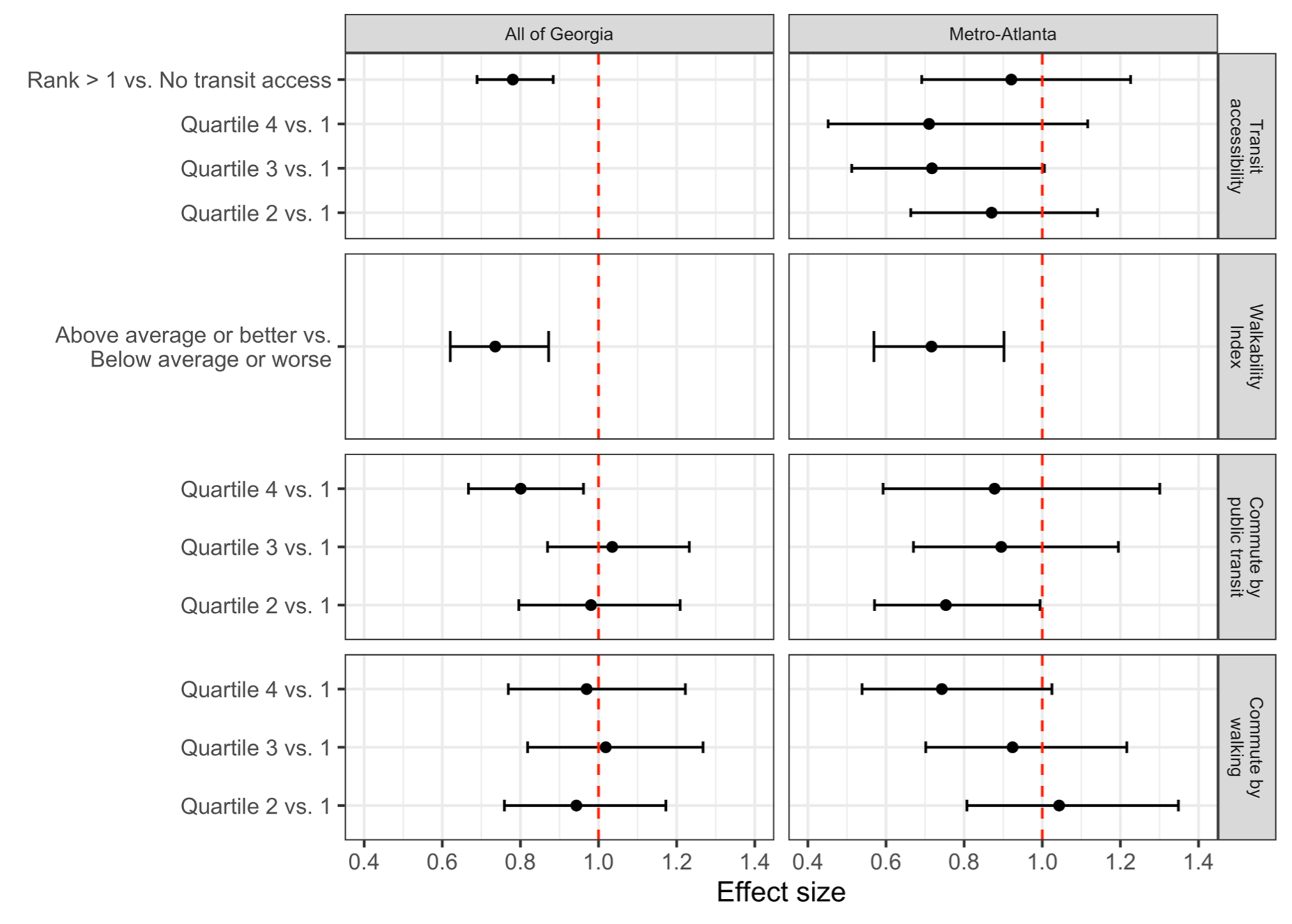
An open-source, publicly accessible data repository where researchers can access scientific results, raw data, and recommended approaches to optimally assess the clinical significance of pharmacokinetic natural product-drug interactions (PK-NPDIs).
My role in developing this site with a multidisciplinary team involved curating and designing its backend PostgreSQL database. I also conducted user testing interviews with pharmacology experts to identify UI-related preferences, and helped implement new use cases and information needs based on these interviews. Features I contributed included leveraging my SQL knowledge with Node.js implementation toward representing natural product experiment results through transforming principal component analysis (PCA) model results into 3-dimensional plots.
Published in Drugs - Real World Outcomes, 2017
The aims of this study were to investigate an association between potentially harmful medication (PHM) use and change in health-related quality of life among community-dwelling older adults, and to compare the predictive capacity of PHM scales…
Download here
Published in American Medical Informatics Association 2018 Annual Symposium, 2018
Pharmacokinetic interactions between natural products and conventional drugs can adversely impact patient outcomes. These complex interactions present unique challenges that require clear communication to researchers. We are creating a public information portal to facilitate researchers’ access to credible evidence about these interactions. As part of a user-centered design process, three types of intended researchers were surveyed: drug-drug interaction scientists, clinical pharmacists, and drug compendium editors…
Download here
Published in Drug Metabolism and Disposition, 2020
There are many gaps in scientific knowledge about the clinical significance of pharmacokinetic natural product-drug interactions (NPDIs) in which the NP is the precipitant and a conventional drug is the object. The National Center for Complimentary and Integrative Health created the Center of Excellence for NPDI Research (NaPDI Center) (www.napdi.org) to provide leadership and guidance on the study of pharmacokinetic NPDIs. A key contribution of the Center is the first user-friendly online repository that stores and links pharmacokinetic NPDI data across chemical characterization, metabolomics analyses, and pharmacokinetic in vitro and clinical experiments (repo.napdi.org)…
Download here
Published in Innovation In Aging, 2021
Medication exposure is a potential risk factor for falls and subsequent death and functional decline among older adults. However, controversy remains on the best way to assess medication exposure and which approach best predicts falls. The objective of the current study was to examine the association between different measures of medication exposure and falls risk among community-dwelling older adults.
Download here
Published in JAMIA Open, 2021
Alert fatigue is a common issue with off-the-shelf clinical decision support. Most warnings for drug–drug interactions (DDIs) are overridden or ignored, likely because they lack relevance to the patient’s clinical situation. Existing alerting systems for DDIs are often simplistic in nature or do not take the specific patient context into consideration, leading to overly sensitive alerts. The objective of this study is to develop, validate, and test DDI alert algorithms that take advantage of patient context available in electronic health records (EHRs) data.
Download here
Published in Drugs Real World Outcomes, 2022
The purpose of this study was to determine changes in the QTc interval in patients taking hydroxychloroquine with or without concomitant QT-prolonging medications, analyzing data from a large-scale retrospective health records database.
Download here
Published in Pediatric Blood & Cancer, 2022
There is limited understanding of pain, psychological comorbidities associated with pain and HRQoL following transplantation for SCD. This study aimed to determine the feasibility and acceptability of collecting data on pain, patient-reported outcomes (PROs), HRQoL and experimental pain sensitivity using quantitative sensory testing (QST), and to compare these before and following HCT in patients with SCD. We hypothesized that there would be a decrease in pain burden following HCT and improvement in pain-associated psychological comorbidity.
Download here
Published in PAIN, 2024
In this study, we leveraged data previously collected in the landmark PiSCES study to examine the HICP phenotype in SCD. We proposed to compare the pain phenotype and outcomes between those with a HICP-like phenotype, hereafter referred to as the HICP group, with those who had CP but did not have HICP, hereafter referred to as the No-HICP group. We also examined the association between HRQoL outcomes and HICP status.
Download here
Published:
This is a description of your talk, which is a markdown files that can be all markdown-ified like any other post. Yay markdown!
Published:
This is a description of your tutorial, note the different field in type. This is a markdown files that can be all markdown-ified like any other post. Yay markdown!
Published:
This is a description of your talk, which is a markdown files that can be all markdown-ified like any other post. Yay markdown!
Published:
This is a description of your conference proceedings talk, note the different field in type. You can put anything in this field.
Undergraduate course, University 1, Department, 2014
This is a description of a teaching experience. You can use markdown like any other post.
Workshop, University 1, Department, 2015
This is a description of a teaching experience. You can use markdown like any other post.